

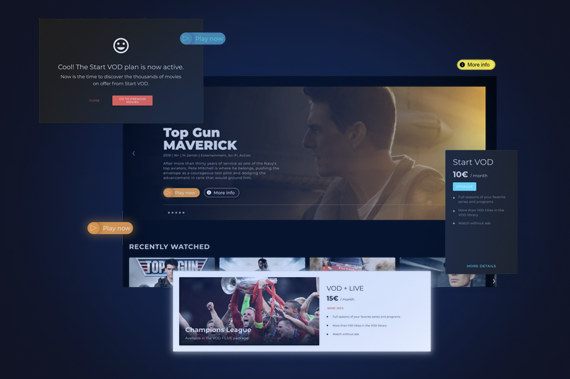
Netflix works on the assumption that it has roughly 60 to 90 seconds before a viewer loses interest and leaves. Gracenote’s 2025 State of Play report puts the average global search time at 14 minutes per session. The distance between those two numbers is where catalogue value quietly disappears. Most operators respond by licensing more content. The cheaper fix is structural: a video content taxonomy that tells every discovery surface on your platform what each asset actually is.
What a video content taxonomy is, and where metadata fits
A video content taxonomy is the classification layer that defines how assets in your library relate to each other. It sets the categories, the hierarchy between them, and the rules for what belongs where.
Three terms get used interchangeably and shouldn’t be:
Taxonomy is the structure. It answers “how is this library organised, and what sits under what”. A sports platform might run four levels: sport, competition, season, asset type.
Metadata is the descriptive record attached to each asset: title, synopsis, language, duration, production year, rights window, participants, aspect ratio, accessibility features.
Tags are the flexible layer that cuts across the hierarchy. A tag like derby or debut-goal connects assets that live in completely different branches of the tree.
The hierarchy handles browsing. Metadata handles filtering and rights enforcement. Tags handle the lateral connections that recommendation engines and editorial rows depend on. Remove any one of the three and you get a specific, predictable failure: no hierarchy means users can only search; no metadata means you cannot enforce geo-blocking or surface language variants; no tags means every “more like this” row falls back to genre, which is the bluntest signal you have.
In practice the hierarchy is the part teams over-engineer and the tags are the part they neglect.
The 90-second window is the real design constraint
Discovery friction is measurable and it is getting worse. Gracenote’s 2025 State of Play report, based on 3,000 consumers across six markets, found that:
- Search time averages 14 minutes globally, and 12 minutes in the US, up from 10.5 minutes in 2023
- 19% of viewers abandon a session entirely when they cannot find something, rising to 29% among 18 to 24 year olds
- 45% describe the streaming experience as overwhelming
- 49% say they would cancel a service because content is hard to find
Set that against Parks Associates research published in February 2026: the average US internet household now carries 5.8 streaming subscriptions, and roughly one in four subscribers cancel once they finish the specific show they signed up for. Your retention problem is often a surfacing problem. The next relevant asset exists in your library, and the platform failed to put it in front of the viewer within the window where they were still paying attention.
Here is the honest limit of this argument. Taxonomy does not fix a thin catalogue, and it does not beat price sensitivity. Parks found that 30% of cancellations are driven by households cutting expenses, which no metadata schema will solve. What taxonomy does is make sure the content you already paid for gets watched, which is the only lever in that list you fully control.
Five layers that hold up in production
Most taxonomies fail because they were designed for a launch catalogue and never revisited. These five layers scale.
1. Genre and subgenre
The entry point for browsing. Keep the top level short, ideally under ten values, and let subgenres carry the specificity. Football, tennis and combat sports sit under Sports; reality, drama and comedy under Entertainment. A viewer answering “what do I feel like watching” should not have to read a list of thirty options.
2. Asset type
Live stream, full match, full episode, highlights package, short clip, interview, press conference. This layer maps directly to available time, which is the strongest predictor of what someone picks on a mobile device at 8pm. It is also what lets you build a “5 minutes or less” row without hand-curating it.
3. Event hierarchy
For sport and live entertainment, content is organised around moments, not seasons of a series. The path competition to season to matchday to fixture to asset mirrors how fans already think. Get this right and you can generate an entire browse structure automatically from the fixture list, rather than having an editor build rows by hand every week.
4. Audience and context segments
Kids, casual viewer, committed fan. These are not demographic labels, they are depth-of-interest labels. A casual viewer wants the three-minute highlights; a committed fan wants the full replay, the tactical breakdown and the post-match press conference. Tagging depth lets you serve both from the same catalogue without splitting your platform in two.
5. Contextual and compliance metadata
Language, region, rights window, participants, production year, accessibility features. This layer is invisible to viewers and it is what breaks first at scale.
Accessibility metadata is no longer optional in Europe. Since 28 June 2025, the European Accessibility Act requires providers of audiovisual media services to make programme guides navigable and to clearly indicate which programmes carry accessibility features such as subtitles, audio description or sign language interpretation. That is a taxonomy field with a compliance deadline attached, and platforms that stored access services as a note in the asset description are now rebuilding it as structured data.
What a clean taxonomy is worth commercially
Omdia expects the combined TV and video market to reach $1 trillion by 2030, with premium video advertising already at $42.1bn in 2025 and growing 15.6% year on year. Advertising is where structured content data converts into revenue most directly, because contextual targeting on connected TV runs on content signals. If your asset record says “Match_final_v3.mp4” and nothing else, that inventory sells at a generic rate.
Three commercial mechanisms depend on the classification layer:
Recommendation quality. Collaborative filtering needs behavioural data, which new platforms and long-tail assets do not have. Content-based similarity fills that gap, and it runs entirely on your metadata. Poor tagging means your cold-start problem never ends.
Packaging and upsell. Tournament passes, season bundles and themed collections are taxonomy queries with a price attached. If competition and season are proper structured fields, a new package is a configuration change. If they are free text in the title, it is a manual curation job every time.
Ad and sponsorship targeting. Sport, competition and participant tags let you sell a sponsor the exact context they want. This matters more each year as more of the best OTT monetisation strategies shift towards hybrid and ad-supported models.
Restructuring a live library without breaking it
Across the 30-plus tenants running on Better Media Suite, the migrations that go badly follow the same pattern: the catalogue grew across three or four content managers who each invented their own conventions, and nobody noticed until the platform tried to build an automated season row.
A typical example from a federation archive migration: the same club appears as “FC Barcelona”, “Barcelona” and “Barca” depending on who ingested the asset. The same season appears as “2019/20”, “2019-2020” and “19/20”. To the database these are six distinct values. To the viewer, the season filter is broken and half the archive is invisible. Nothing is wrong with the video files. Everything is wrong with the strings around them.
The sequence that works:
Step 1: Audit before you design. Export every asset with its full metadata record and count distinct values per field. The fields with hundreds of near-duplicate values are your damage report. Also count assets with empty required fields, because those are the items already invisible to search and recommendations.
Step 2: Define a controlled vocabulary, not a category list. For every field that feeds discovery, decide the permitted values and lock them. Free-text entry on a field that powers a filter is the single most reliable way to destroy a catalogue over 18 months. Where a value genuinely varies, use an ID and a display name, so renaming a competition does not orphan 400 assets.
Step 3: Write the naming rules down and enforce them at ingest. Title format, participant name format, date format, mandatory versus optional fields. Enforcement belongs in the CMS as validation, not in a wiki page that nobody reads. Rejecting an asset at upload costs a minute; finding it two years later costs a migration.
Step 4: Automate enrichment, keep humans on QA. Speech-to-text makes dialogue and commentary searchable. Scene and logo detection identifies key moments. Automated tagging is fast and reasonably accurate on broad categories, and unreliable on the specifics that matter most to fans, such as distinguishing two players with similar appearances. Treat machine tags as suggestions with a confidence score and route low-confidence output to a human. The AI in media and entertainment market is forecast by Grand View Research to grow from $43.1bn in 2026 to $159.3bn by 2033, and most of that spend will land on exactly this kind of enrichment work.
Step 5: Measure the taxonomy, not just the content. Track zero-result searches, filter combinations that return nothing, and assets with no plays in 90 days. Zero-result searches are the most useful signal you have, because they are viewers telling you in their own words what your vocabulary is missing. Review monthly, adjust quarterly.
The failures that cost the most
Hierarchies deeper than three levels. Every additional level multiplies the tagging burden and the chance of inconsistency, while adding almost nothing for the viewer.
Tags as a dumping ground. When tags have no vocabulary and no owner, you end up with 4,000 of them, 3,600 used exactly once. That is noise to a recommendation engine, not signal.
No named owner. Taxonomy without an accountable owner degrades by default. Someone needs the authority to reject a new category.
Treating it as a launch task. Catalogues change, competitions rebrand, formats appear. Vertical short-form is the current example, and platforms that had no asset type for it improvised, badly. If you are planning a launch, the OTT platform launch checklist is the right place to settle this before ingest begins, and operators running specialist catalogues will recognise the same constraints in white-label OTT platforms for niche sports.
One clarification worth making: internal taxonomy and public search visibility are related but separate jobs. Structured metadata helps both, and the specifics of ranking pages and video schema are covered in SEO for OTT platforms.
Where this leaves you
A video content taxonomy is infrastructure, and like most infrastructure it is invisible when it works and expensive when it doesn’t. The measurable outcomes are narrow and real: less time to first play, fewer abandoned sessions, more of the catalogue actually watched, cleaner inventory for advertisers, and packaging you can change without a manual curation project. It will not rescue a catalogue nobody wants. It will stop a good catalogue from behaving like a bad one.
Better Media Suite gives content teams the structured hierarchy, controlled vocabularies, bulk metadata operations and validation rules to keep a growing library consistent across web, mobile and 10+ CTV platforms, with six monetisation models running off the same classification layer.
Ready to see how your catalogue would look with a working taxonomy behind it? Request a demo and we’ll walk through it with your own content structure.
FAQ
Review the vocabulary monthly and the structure quarterly. Monthly reviews should look at zero-result searches, new tag values created and assets missing required metadata, which take under an hour. Structural changes, such as adding a level or a new asset type, need a quarterly cycle because they require re-tagging existing content and updating ingest validation.
Taxonomy is the classification structure that defines categories and how they nest, for example sport to competition to season. Metadata is the descriptive information attached to each individual asset, such as title, language, duration, rights window and participants. Taxonomy tells you where an asset sits in the library; metadata tells you what it contains.
Partly. Speech-to-text, scene detection and object recognition reliably produce broad categorical tags and searchable transcripts at a fraction of manual cost. Accuracy drops on domain-specific detail, including individual player identification and event context. The practical setup is automated tagging with confidence scores, where anything below your threshold is routed to a human reviewer before publication.
Allowing free-text entry on fields that power filters and recommendations. Within a year you have multiple spellings of the same team, competition or season, each treated as a separate value by the database. Filters return incomplete results and recommendation engines lose the connections between related assets. Controlled vocabularies enforced at ingest prevent it.
Yes, directly. Contextual targeting on connected TV depends on structured content signals such as genre, competition, participants and asset type. Inventory attached to a well-described asset can be sold against a specific context and commands a higher rate than inventory with only a filename and duration. Premium video advertising reached $42.1bn in 2025 according to Omdia.