

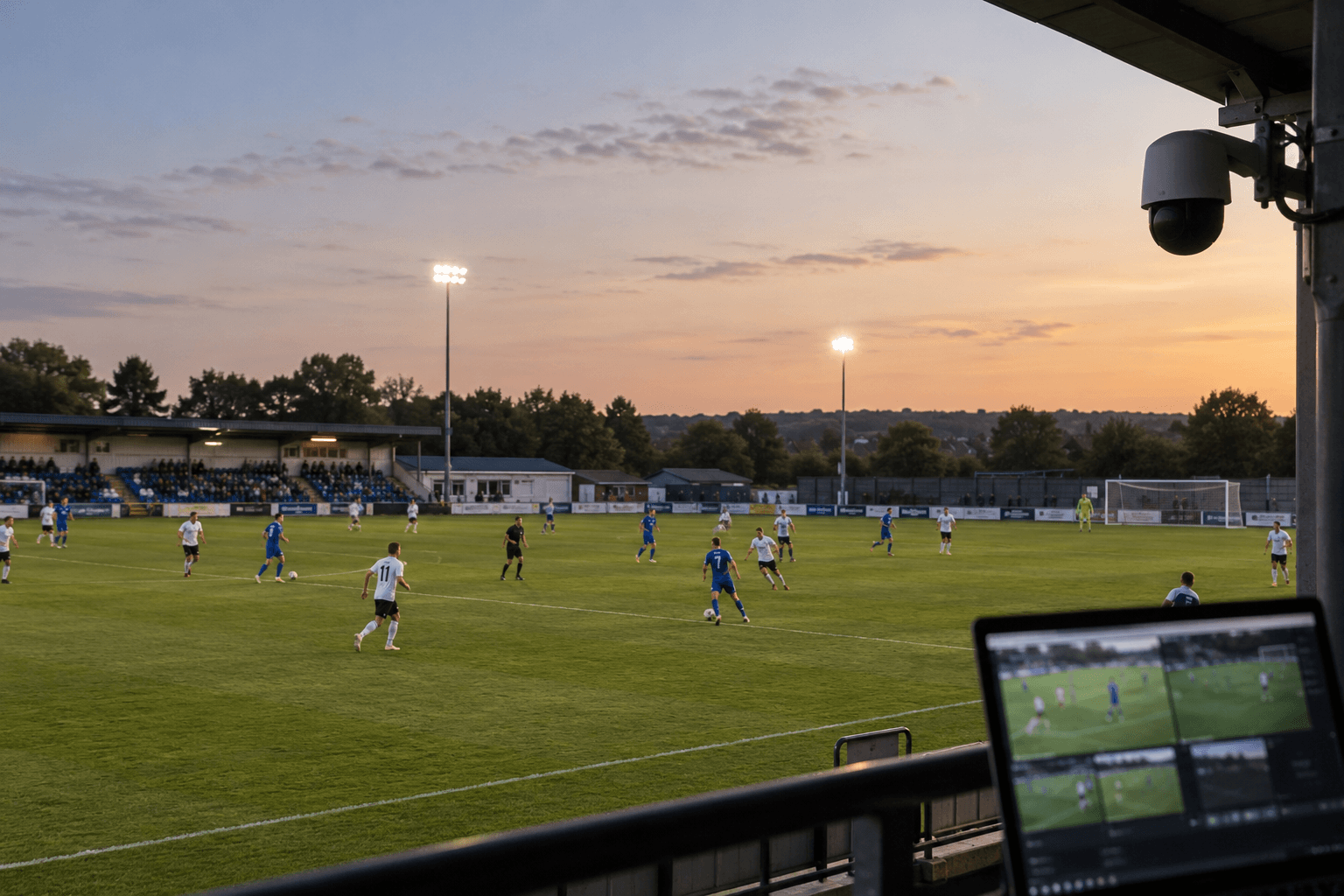
Most matches below the top tier never reach a screen. A traditional multi-camera production needs camera operators, a director, a graphics operator and someone on replays at every fixture, and for a regional league that cost rarely matches what a single game brings in. Automated multi-camera sports production changes the maths by automating selected production tasks. WinSportEdge runs that analysis in the cloud and, together with Better Media Suite, turns each match into live coverage, on-demand video, highlights and structured match data.
What a match-day crew does, and what software can automate
A conventional sports broadcasting setup splits into roles. Camera operators follow the play. The director chooses which angle goes to air. The graphics operator keeps the score and clock on screen, and the replay operator marks the moments worth showing again.
Every one of those jobs depends on the same skill: recognising what’s happening on the pitch or court in real time.
That’s the part AI-powered computer vision now handles well enough to take on a share of the work. Researchers at JD AI Research described an event-driven directing system for multi-camera sports broadcasting back in 2022, built on the idea that once software can detect events, it can support the directing decisions those events call for. The technology has since moved from research papers into professional sports production.
Automating camera selection, event detection and other production tasks reduces the amount of on-site production work each fixture needs. That makes it easier to extend coverage across more venues and competitions, up to a national scale, including fixtures that would never justify a full production crew. The exact split between automated and manual work is agreed for each deployment, because it depends on the sport, the venue and the camera setup.
From camera to fan: how WinSportEdge fits into Better Media Suite
The full feature set is on the WinSportEdge AI sports video analysis page. The production workflow runs in five stages, with WinSportEdge in the middle turning pictures into data.
1. Cameras
WinSportEdge can work with existing camera infrastructure, provided the setup gives the system the coverage and synchronisation it needs. Camera position and field of view matter more than the brand of hardware, and there’s no closed camera ecosystem to buy into.
Facilities range from modern arenas to municipal pitches with one usable gantry, so every deployment starts by checking what each venue can capture.
2. AI analysis in the cloud
Feeds go to the cloud, where WinSportEdge detects and tracks players and the ball and recognises game events across several cameras at once. The analysis method is patented (Polish patent Pat.235125) and processes live streams and recorded video files in less time than the footage takes to play. In practice, analysis keeps pace with the match.
3. Data and events
The analysis produces a data feed of player and ball positions, recognised events and their timestamps. That data drives the production process: the system selects the angle that shows the action, generates live graphics and marks moments for replays and clips. Because the same logic runs at every game, coverage looks consistent from the smallest ground to the biggest.
4. Live stream and OTT platform
The produced stream goes into Better Media Suite and out to web, mobile and more than ten connected TV platforms, live and on demand, with no export step or extra system to manage content. A match produced at a small ground reaches viewers anywhere in the world, live.
5. Web application
Coaches, analysts and fans work with the results in the web application, including event timelines, clips, player previews and a player-following view.
That end-to-end flow is what sets WinSportEdge apart. Standalone sports analysis tools stop at the data, camera-only systems stop at the stream, and this workflow carries a match from camera ingest through to apps and monetisation.
One fixture, several outputs
The value of a produced match doesn’t end with the final whistle. Because WinSportEdge categorises footage in real time, the same processing that powers the live broadcast produces everything else. One fixture can give you:
- live coverage on your own apps
- full-match video on demand
- automatically tagged events: goals, chances, set pieces, player involvement
- highlight reels and clips for OTT and social platforms
- player data and player previews
- coaching and analytics data for your staff
That turns highlight creation from an editing job into a publishing rule. Your highlights output grows with the fixture list rather than with editing hours, and clips stay consistent because they’re cut by the same rules every week.
The data side has value of its own. Grand View Research values the video analysis segment of sports analytics at $968.1 million in 2024 and expects it to reach $3,418.4 million by 2030, with Europe the largest regional market in 2024. If you’re producing match video for sports fans anyway, the same assets can serve teams and coaches too.
Player-following view
Tracking data has a second use beyond analysis. In the web application, viewers can follow a chosen player through a match, using the same multi-camera feeds and tracking data that drive the main broadcast, with player previews pulling together that player’s key moments.
That serves audiences a full broadcast can’t serve on its own: a parent watching their daughter rather than the whole under-16s match, a coach reviewing one player’s positioning, a scout assessing a prospect without travelling.
Selling access on your own platform
Production only pays off if the coverage earns something. Connected to Better Media Suite, each competition can sell access through the model that suits its audience: subscriptions (SVOD), pay-per-view (TVOD), advertising (AVOD and FAST), or a hybrid or freemium mix. A season pass for the top division, free ad-supported youth football and pay-per-view for a cup final can all run on the same platform.
Grand View Research projects the global sports streaming platforms market to reach $68.30 billion by 2030, growing 12.6% a year. Leagues that run their own OTT platforms keep their share of that growth instead of renting access to their own audience. If you’re weighing that against third-party channels, our comparison of owning your video platform versus YouTube sets out what each option leaves you.
Competitions such as Futsal Ekstraklasa TV already distribute on Better Media Suite, and WinSportEdge adds the production step in front of that distribution. For revenue beyond the paywall, see how sports organisations can monetise live streams beyond subscriptions.
What automation won’t do
Automated production fits high-volume coverage of sports events best, and the scope of automation is agreed for each deployment. It’s a weaker fit in four places.
Commentary and studio analysis stay human. Software can support the pictures, but the storytelling around a derby still comes from people. Many leagues add remote commentary on top of the automated feed.
Accuracy depends on the camera setup. Camera position, field of view, lighting and players bunched together at a corner all affect how well the system can capture and track the action. A well-placed camera does more for output quality than any model update.
Connectivity is the hard dependency. Cloud production means uploading feeds from the ground, so each venue’s upstream connection decides what’s possible there.
Flagship fixtures still justify a crew. If you’re delivering a final to a broadcast partner with contractual production standards, a traditional or hybrid workflow like the one in our live event production best practices is still the right call. Automation tools extend coverage to the rest of the calendar.
Rolling it out across a league
- Survey the venues. Camera positions, field of view, synchronisation, power and upstream bandwidth at each ground decide where you can start.
- Agree the scope of automation. Decide which production tasks WinSportEdge handles and which stay with your team, competition by competition.
- Settle rights and consent. Broadcasting players, particularly minors, means agreeing what’s filmed, published and stored. The European Data Protection Board’s guidelines on video devices are a sensible starting reference for your legal team.
- Pilot one competition. Run a handful of games before the season starts, review the output with coaches and fans, and adjust camera positions.
- Choose a monetisation model per competition, matched to the audience it actually has.
- Expand venue by venue. Add grounds once the pilot output meets your standard, then extend the same process to other sports in your federation, such as futsal or basketball.
If you’re still deciding how the platform itself should be structured, choosing a federation OTT platform model covers the options.
Cover more of the fixture list
For most leagues, the limit on coverage has been the cost of on-site production rather than the audience. WinSportEdge automates selected production tasks and, with Better Media Suite, carries each match from camera to OTT app to revenue. You get more matches on screen, more content and data from each one, and a revenue model you control.
Want to see a fixture from your own competition produced with WinSportEdge? Request a demo and we’ll talk you through it with your venues in mind.
FAQ
It’s live sports coverage where software takes on production tasks that would otherwise need people on site: following the play, selecting camera angles, adding graphics and marking replays. AI-powered computer vision detects players, the ball and game events across several feeds, and those events drive the directing decisions. It makes lower-tier and youth fixtures practical to cover without a full production crew at every match.
No proprietary camera ecosystem is required. WinSportEdge can work with existing camera infrastructure, provided the setup gives the system the coverage and synchronisation it needs. Camera position and field of view matter most, so each deployment starts with a venue survey that checks what the cameras can see and whether the feeds can be aligned.
WinSportEdge isn’t limited to football. Detection, tracking and event recognition are designed for team sports more broadly, from futsal to basketball, so federations running several disciplines can produce them on the same system. Event definitions differ between sports, which is why each discipline is configured before its first broadcast. You can confirm support for your specific sports during a demo.
Yes. WinSportEdge’s patented analysis processes live streams in less time than the footage takes to play, so the system keeps pace with the match. The delay viewers actually see depends mostly on the upload connection at the venue and the streaming configuration, rather than on the analysis itself, which is why connectivity is part of every venue survey.
WinSportEdge can automate parts of the production workflow that would normally require on-site resources, including action tracking, camera selection, event detection and content tagging. The exact level of automation depends on the sport, venue and camera setup. Commentary, studio production and flagship broadcasts may still use a traditional or hybrid production workflow.