

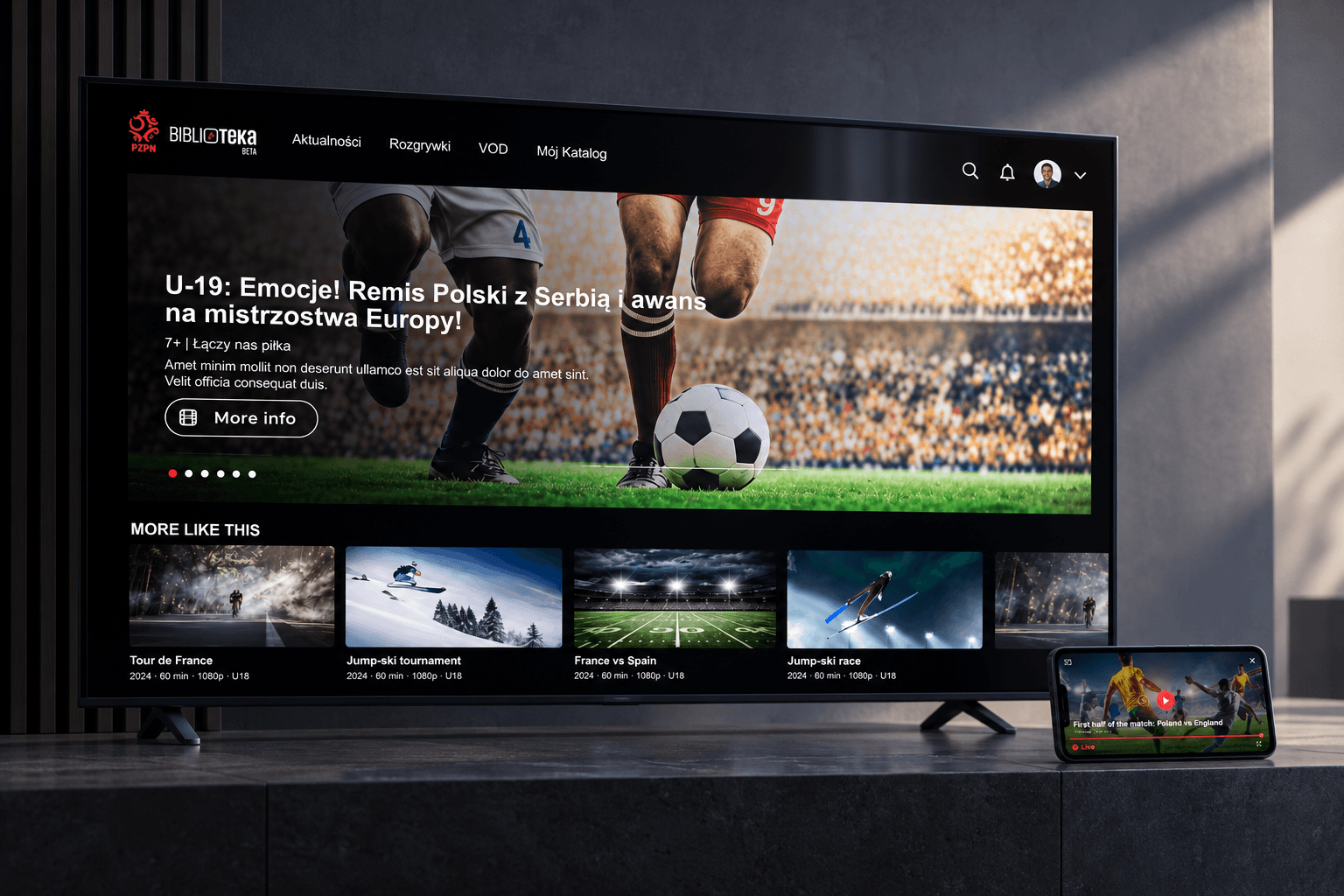
In the summer of 2026, three decisions reshaped how federations think about streaming. FIFA+ moved onto DAZN on 27 May. LaLiga switched off LaLiga+ on 30 June. And on 28 July the Polish Football Association launched PZPN+, free to watch and starting with every game of the women’s top flight. Each points to the same question: which parts of its digital offer a federation should own, and which it should hand to partners. This guide compares the three models federations use, the rights, production and data decisions behind a federation OTT platform, and what to ask before you choose one.
Why federations are rethinking their platforms
LaLiga+ launched in July 2019 as LaLigaSportsTV and hosted handball, futsal, basketball and Primera RFEF alongside the league’s own content. Announcing the closure, LaLiga said the service had fulfilled its cycle and cited fragmented consumption, according to Broadband TV News.
FIFA+ still carries around 8,500 live games a year from roughly 100 member associations in selected markets, but viewers now need a DAZN account linked to a FIFA ID.
The Women’s Super League left The FA Player. For 2024–25, games not shown by the BBC or Sky moved to the league’s YouTube channel. A season later, a new five-year Sky and BBC deal put every WSL game on television, with some fixtures shared non-exclusively with YouTube. As the competition grew, the rights moved back to broadcasters.
None of this means paid services have failed. Ligue 1+, launched by LFP Media in 2025, reported 1.1 million subscribers in February 2026, 80% of them on a paid commitment, although growth had levelled off by the summer. It’s also sold through DAZN, Prime Video and French telcos as well as directly. In May 2026 the DFB launched DFB.TV, a pay channel at €5.99 a month built around youth national teams, the 2. Frauen-Bundesliga, futsal and beach soccer, and distributed through DAZN, HD+, Vodafone and Zattoo. Paid models can work, but the ones that do lean on distribution partners too.
Three models federations are choosing
A standalone destination. Own apps, own paywall, own audience. This fits top-tier rights and a large paying base, although even Ligue 1+ sells through partners, so the line between standalone and hybrid is blurring. It’s also the most expensive to run.
Distribution only. Content goes to YouTube, broadcaster apps or aggregators such as FIFA+. It costs the least and gives the least control over data, pricing and the product.
A hybrid. The federation owns a core layer (identity, rights rules, content management, the archive and first-party data) and distributes through partners on top of it. PZPN+ combines its own platform with planned international distribution through League Exchange. The DFB runs DFB Play abroad alongside OneFootball, a FAST channel and DFB.TV.
The hybrid suits most federations below the top tier, but it only pays off with enough content and a team to operate it.
| Platform | Model | Territory | Core content | Status in 2026 |
|---|---|---|---|---|
| PZPN+ (Poland) | Free | Poland, international distribution planned | ORLEN Ekstraliga Kobiet live, replays, archive | Launched 28 July 2026 |
| DFB Play (Germany) | Free | Outside Germany only | DFB-Pokal, Frauen-Bundesliga, 3. Liga, youth, women’s national team home games | Active, plus OneFootball, a FAST channel and the DFB.TV pay channel |
| ÖFB TV (Austria) | Single federation platform | Austria | National teams, women’s Bundesliga, ÖFB Cup, grassroots | Launched 2020 |
| The FA Player (England) | Federation player | UK | Women’s FA Cup ties, FA content | Lost WSL live rights to YouTube from 2024–25 |
| Ekstraklasa.TV (Poland) | Paid, from €2.99 per game | Markets without an exclusive broadcaster | Ekstraklasa games for fans abroad | Launched 2019, provider re-tendered for 2021–22 |
| LaLiga+ (Spain) | Multi-sport league platform | Spain | Handball, futsal, basketball, Primera RFEF | Closed 30 June 2026 |
| FIFA+ | Free, DAZN account required | Selected territories | ~8,500 live games from ~100 associations | Moved onto DAZN, 27 May 2026 |
What we learned building PZPN’s sports app
We built a sports app for PZPN, the Polish Football Association, to bring the federation’s football video into one place: interviews, match summaries and catch-ups, alongside rankings and other competition information, across web, tablet and mobile. Our case study covers the project. Two lessons from that brief apply to any federation.
A federation already has systems, and the platform has to fit them. PZPN ran its own CMS, CDN and CRM before the app existed, and the app was built to integrate with all three rather than replace them. Content could be managed in the federation’s existing tools, and the CRM integration let PZPN use its own fan data for personalised engagement. For most federations this is the norm: the video platform is one layer in a stack that’s already there.
Video is only part of what fans come for. Rankings and competition information sit next to the video in the same app, because federation fans follow competitions as much as clips. That’s one reason content structure and metadata matter as much as playback.
Start with the rights broadcasters don’t buy
Domestic rights for top-tier men’s football are usually committed for years. In Poland, every Betclic 1. Liga game has been free on TVP Sport since 2024–25: 309 games a season, within an agreement covering 482 transmissions a season until 2027. In Germany, DFB Play can’t be watched inside the country at all.
At home, a federation platform earns its place through the rest of the calendar: women’s football, youth competitions, early cup rounds, lower tiers, regional sport and the archive. That’s why PZPN+ launched with the women’s top flight, and why DFB.TV is built around youth and lower-tier competitions. The same logic runs through every niche sport, as we covered in white-label OTT platforms for niche sports.
How geo-rules and windowing work in practice
Rights rules have to live in the platform as data. Each asset carries its territories, its window start and end, and any blackout. When a viewer presses play, the entitlement service checks who they are, what they’re entitled to and where they’re watching, usually from IP geolocation, before it issues a short-lived playback token. The CDN then accepts only signed requests, so a copied stream URL stops working. VPN and proxy detection narrows the gaps but never closes them completely, and rights partners should hear that plainly.
If changing a rule needs developers, your rights team waits on engineering every weekend. These should be settings the rights team can manage itself.
Production cost sets the ceiling
Streaming a game is cheap compared with producing it. A full women’s league, a youth competition or regional football adds up to hundreds of games a season, and crew-based production doesn’t scale to that. That’s why PZPN+ runs on Spiideo’s automated cameras, the same technology Betclic 1. Liga rolled out for centralised video analysis in October 2025.
In a setup like this, automated cameras push live streams, commonly over SRT or RTMP, to cloud encoding, which packages them as HLS and DASH for web, mobile and smart TV devices. Competition, teams, kick-off time and venue arrive from the fixtures feed and are attached automatically, so each game appears with the right title, rights rules and archive entry, and switches to on-demand after the final whistle.
Highlights are the harder part. BMS runs an EU co-funded R&D project, WinSportEdge, on automated sports production and real-time audio and video tagging, with a total value of PLN 9.8 million. Our live event production best practices cover the operational side of live events.
Free to watch means designing the business case upfront
PZPN+, DFB Play and FIFA+ are all free to watch. For women’s, youth and lower-tier sport, reach and sponsor value usually count for more than subscriptions in the early years.
Three revenue streams tend to carry a free federation platform:
- Competition sponsorship and advertising inside the product, with the title partner’s brand in the player, the rows and the highlights packages.
- Registered-fan data that supports ticketing, merchandise and national team campaigns, and gives sponsors insights into fan engagement.
- Premium or pay-per-view tiers added later for specific events or audiences.
The design decision that matters is flexible monetisation per competition. If free access, ads, subscriptions and pay-per-view are configurable from the start, a paid tier in year two is a settings change. Our guide to how sports organisations monetise live streams beyond subscriptions covers the commercial options.
Distribution, and who actually owns the fan data
Fans watch on YouTube, DAZN, OneFootball and broadcaster apps, and increasingly on smart TV screens. Ampere Analysis data reported by TV Tech shows smart TVs now take 31% of internet users’ viewing time, averaging 90 minutes a day, up 27% in four years.
What distribution gives you in data is a separate question. On your own apps you hold first-party data: who registered, what they watched, on which device, for how long. On YouTube you usually get aggregate channel analytics rather than identifiable viewers. On broadcaster apps or platforms such as DAZN, anything beyond audience totals has to be negotiated.
Account linking is the mechanism to watch. FIFA+ viewers need a DAZN account linked to a FIFA ID, which keeps a FIFA identity in the picture, although how much viewing data flows back depends on terms that aren’t public.
Three practical rules follow. Write data-sharing terms into every distribution contract: what is shared, how often and at what level of detail. Use syndicated clips to drive registration on your own platform. And count registered users on your own apps, not total views across partners, as the audience you own.
Premium moments attract pirates
In an October 2025 open letter to the European Commission, 36 sport and media leaders said 81% of illegal live streams detected in Europe in 2024 were never suspended, and fewer than 3% were removed within 30 minutes. For national team games and big fixtures, security belongs in the launch scope: DRM across Widevine, FairPlay and PlayReady to cover Android and Chrome, Apple devices and most smart TVs, token-based access, concurrent-stream limits and live monitoring.
Eight questions to ask a platform partner
Federations outlive vendors. Ekstraklasa re-tendered its OTT provider for 2021–22, and Vimeo On Demand closes on 20 November 2026. Before you sign with any of the white-label OTT platforms on your shortlist, get these answered in the contract:
- Can we export users, entitlements, the archive and metadata in bulk, in a machine-readable format?
- Which smart TV and mobile platforms are covered at launch, and who handles certification and support?
- Can clubs and regional associations have their own permissions, pages and upload rights within one platform?
- Can the rights team configure territory rules, windows and blackouts without developers?
- Will the platform ingest feeds from any production vendor, or only one?
- Can we switch between free, advertising, subscription and pay-per-view per competition without custom work?
- Can analytics from our own apps and from partners such as YouTube sit in one view?
- What are the exit terms, and what happens to our data if the vendor is acquired?
If you’re earlier in the process, our guide to launching a sports streaming platform on white-label OTT covers the launch steps.
What your own platform won’t fix
A federation platform won’t replace broadcaster rights revenue, and it won’t create an audience that doesn’t exist yet. Women’s and youth competitions often start small, and your own analytics will show it. The bigger challenge is running it: rights administration, content operations, fan support and monitoring every weekend. If a federation holds little content outside its broadcast deals and has no team to operate a platform, distribution alone may be the more honest choice for now.
Choosing your model
There’s no single right answer for every federation. A standalone service can work with top-tier rights and a paying audience. Distribution alone can work when there’s little content of your own. For most federations in between, a hybrid is the practical option: own identity, rights rules, content management and first-party data, and distribute through partners on terms that bring some data back. Whichever you choose, make sure your platform fits the systems you already run and lets you take your content and your fans with you when the brief changes.
Better Media Suite runs across 30+ tenants and 10+ connected TV platforms, with six monetisation models configurable per competition and apps, content management and analytics in one system. If you’re weighing your options, request a demo and we’ll walk through them with your own competition structure.
FAQ
It depends on its rights and audience. Top-tier domestic rights usually sit with broadcasters, so a federation platform earns its place through content they don’t buy: women’s and youth football, lower tiers, regional games and the archive. Federations with top-tier rights and a large paying audience can run a standalone service, while those with little content outside broadcast deals may be better served by distribution alone.
Only where the contract allows it. The usual pattern is to stream outside the broadcaster’s territory, as DFB Play does by geo-blocking Germany, or to stream competitions and windows the broadcaster doesn’t hold. That makes territory rules, delayed windows and blackouts core platform features, and they should be configurable by the rights team rather than hard-coded for each game.
Only what the partner’s tools and your contract allow. YouTube typically provides aggregate channel analytics rather than identifiable viewers, and broadcasters or platforms such as DAZN share data on negotiated terms. First-party data, such as registrations, viewing history and devices, comes from your own apps. That’s why federations use syndicated clips to drive sign-ups and write data-sharing terms into every distribution agreement.
Most federations launch free. PZPN+, DFB Play and FIFA+ are all free to watch, because reach and sponsor value matter more than subscription revenue for women’s, youth and lower-tier sport. Paid models can work, as Ligue 1+ shows with top-tier rights and DFB.TV with a low-priced channel sold through pay-TV partners. The safer design is free at launch, with paid tiers that can be switched on later.
At minimum: apps for web, mobile and smart TV devices, content management for live streams, highlights and the archive, configurable territory rules, and monetisation that supports free access, ads, subscriptions and pay-per-view. Federations also need permissions for clubs and regional associations, analytics that prove audiences to sponsors, and security such as DRM and token-based access for premium games.